How the World Is Evolving Right Before Our Eyes
The evolutionary history of life records the major events in the development of life on Earth. How did life on Earth evolve step by step from tiny single-celled organisms into the diverse and colorful organisms we see today, including complex human societies? From the lush vegetation of the Amazon rainforest to the vibrant marine life of the Great Barrier Reef, what forces drove the evolution of life behind all this vitality? When we explore the fossil record, trying to find those major events that changed history, we may focus on the earliest records of fish that could crawl on land, or the early apes that walked on two legs like us. But these landmark events in evolution are only superficial changes, representing only shifts in morphology and survival methods, not a significant leap in the complexity of organisms. The question of "how the world evolved before our eyes" can be understood from two levels: the history of scientific evolution and the philosophy of perception.
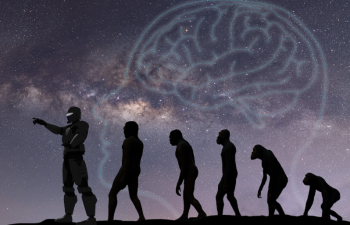
- Earth's formation (approximately 4.6 billion years ago): Formed from the condensation of the primordial nebula of the solar system, initially a hot magma ball, frequently subjected to meteorite impacts.
- The birth of the moon (approximately 4.5 billion years ago): Earth collided with Theia, a Mars-sized celestial body, ejecting material that formed the moon, stabilizing Earth's axis of rotation and slowing its rotation speed.
- The origin of oceans and life (approximately 4.0–3.7 billion years ago): Comets brought water, forming primordial oceans; cyanobacteria released oxygen through photosynthesis, gradually altering the atmospheric composition.
- The explosion of complex life (approximately 600 million years ago): The Cambrian explosion saw the emergence of multicellular animals, followed by multiple mass extinctions and revivals.
- The Rise of Humanity (approximately 2 million years ago): Homo sapiens evolved from apes and, through tool use, language, and abstract thinking, became the dominant species on Earth.
From a perceptual perspective: The world we "see" is an illusion constructed by the brain
- Sensory limitations: Visible light occupies only a very narrow range of the electromagnetic spectrum (400–700 nanometers); other wavelengths such as infrared, ultraviolet, and radio waves are invisible.
- Active Brain Construction: Vision is not a passive reception of images, but rather the brain's "best guess" of ambiguous sensory signals based on past experience. For example, the "rubber hand illusion" experiment demonstrates that the brain can incorporate prosthetics into its own body schema.
- Evolution Prioritizes Adaptability over Reality: University of California professor Donald Hoffman proposes that natural selection shapes adaptive illusions—those that guide survival behavior need not reflect reality. For example, seeing a "snake" doesn't require knowing its actual molecular structure; simply recognizing it as a threat and avoiding it is sufficient.
- Holographic Universe Hypothesis: Some physicists (such as Gerald Hooft) speculate that the universe may be a holographic projection of two-dimensional information, and the three-dimensional world we perceive is merely a representation.